Most brides walk into our St. Petersburg boutique with a mermaid gown saved on their phone or a ball gown they’ve wanted since they were little. A lot of them leave in love with an A line wedding dress, and nobody is more surprised than they are.
The shape is simple. It fits through the bodice, then widens in one long, gentle slope from the waist to the hem, so the skirt skims your hips instead of gripping them. In Tampa Bay, where you may be standing on a seawall or sinking into soft Gulf sand, that simplicity does a lot of work.
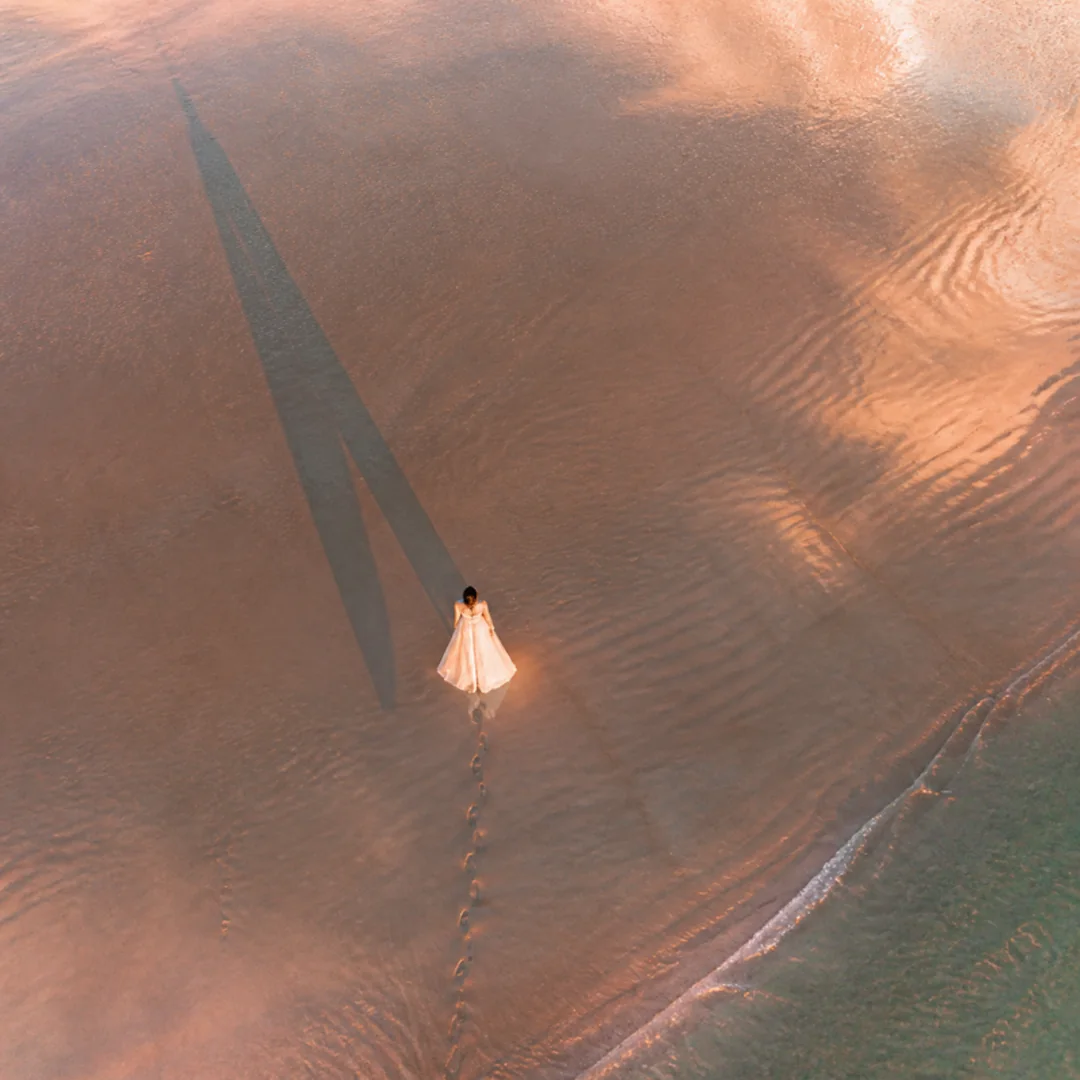
It isn’t always the right answer, and we’ll tell you when it isn’t.
Why do so many brides end up in an A line wedding dress?
Because it suits the widest range of bodies and venues with the least fuss. You can sit down in it and walk to the bar without anyone holding your skirt.
Our stylists watch the same scene play out all the time. A bride tries the dramatic gown she came in for, loves the first ten seconds, then notices she can’t take a full step. She tries an A line wedding dress next, her shoulders drop, and she stops posing and starts walking around the room.
The name is older than most brides realize. Christian Dior used it for his spring 1955 collection, and the Metropolitan Museum of Art describes that A-line as a smooth silhouette that widened over the hips and legs until it resembled a capital A. His version had an undefined waist. A modern A line wedding dress usually marks the waist, and that’s where the flattery comes from, because your eye lands on the narrowest point and then follows the skirt down.
If your hips are the part you’ve been worrying about, the skirt skims right past them. If you’re petite, one unbroken line from bust to floor adds height. Our guide to every wedding dress silhouette walks through the other shapes if you want to compare before you come in.
How does an A line bridal gown behave on a Tampa Bay waterfront?
Better than most shapes, because the skirt has room to move and enough weight to settle. It lifts in a breeze, swings, and falls back into place.
That matters more here than brides from inland expect. Stand on the water at the St. Pete Pier or the lawn at a bayfront venue and the wind finds you, usually in the afternoon. A slim sheath wraps around your legs and shows everything. A big ball gown catches the same gust like a sail, and now two bridesmaids are wrestling it. An A line wedding dress sits between those two extremes.
Ask your venue which way the ceremony faces and what the wind usually does at your hour. Then tell your stylist, because that one detail can change which skirt we pull.
Summer adds water to the plan. The National Weather Service office for our area puts the rainy season for most of West Central Florida at about May 25 to October 10, with showers and thunderstorms over the peninsula almost daily. A wet lawn and a quick dash indoors are real possibilities, and an A line wedding dress lets you lift the front with one hand and go. Try that in a mermaid skirt.
Our outdoor wedding dress guide for Tampa Bay covers more of what Florida does to a gown.
Does an A line work as a beach wedding dress on the Gulf?
Yes, as long as you keep the fabric light and the train short. Soft sand at Pass-a-Grille or Siesta Key is harder on a gown than almost anything else you’ll ask it to do.
Sand behaves like a slow drag on every step. A heavy skirt collects it, and a long train hauls it down the aisle behind you. We’d take a lightweight A line wedding dress with a short sweep train over a cathedral train every time on the beach, and we’d tell you to skip the heels. Your heel will sink, the dress will drop an inch, and the front hem will catch under your foot.
So decide on your shoes before your first fitting, even if your shoes turn out to be no shoes. Alterations are handled in house at our boutique, and your seamstress will set the hem to whatever you’re actually standing in. Barefoot at Fort De Soto and strappy sandals on a Clearwater Beach deck are two different hems.
One more thing brides from out of state tend to miss. Wet sand near the waterline is firmer and much easier to walk on, but your hem will get wet, and it will show in the photos at the end of the night. Some brides love that. Decide now so you aren’t upset about it later.
Which fabric keeps an A line gown comfortable in Florida?
Chiffon, organza, soft lace and crepe are the ones we reach for from April through October. They breathe, and they don’t fight the breeze.
Crepe gives you a clean, modern line. Chiffon floats and photographs beautifully on the water, though it will blow across your face if you stand with your back to the wind. Lace hides wrinkles from the car ride, which is an underrated quality in a fabric.
Mikado and dense satin hold the sharpest shape of anything we carry, and we love them. We’d also save them for a January evening at The Vinoy or a ballroom with serious air conditioning, because they trap heat and they’re heavy by the end of a long reception. Heavy doesn’t mean wrong. It means you should pick it knowing the tradeoff.
You’ll find an A line wedding dress across our designers, from Stella York and Maggie Sottero to the softer, boho side of All Who Wander. Our wedding dress fabrics guide goes deeper if you want to feel your way through the options first.
When is an A line the wrong call?
An A line is the wrong call when you want your curves on display. It skims the hips and thighs by design, so a bride who has been waiting her whole life to wear something fitted will feel hidden.
If that’s you, try a fit and flare and don’t apologize for it.
It can also read too quiet for a very grand room. A bride walking into a large ballroom who wants a real entrance may be happier in a ball gown, and we’ll say so. On the other end, a stiff, heavily layered skirt can swallow a very petite frame, so a small bride should look for lighter fabric rather than assume the shape will save her.
The worst reason to choose it is that it feels safe. We’d rather you try the mermaid, hate it, and come back to the A line wedding dress with your mind made up than wonder about it for the next eight months.
Frequently asked questions about the A line silhouette
What is an A line wedding dress?
It’s a gown that fits through the bodice and widens gradually from the waist to the hem, tracing the shape of a capital A. There’s no dramatic flare and no big volume at the hip. At The Dressing Room in St. Petersburg, it’s one of the first shapes we suggest to a bride who isn’t sure where to start.
Does the A line suit every body type?
Close to it, which is why the A line wedding dress is so popular. The skirt skims the hips and thighs, the waist gives you definition, and the long line adds height. The main exception is a bride who wants to show her curves, since this shape hides them by design. Your stylist will tell you honestly how it looks on you.
Is an A line a good choice for plus size brides?
Yes, an A line wedding dress is one of the most comfortable and supportive shapes for a fuller figure. The structure sits in the bodice and the skirt falls without clinging. We carry sizes up to 30 in St. Petersburg, and you can read more on our plus size wedding dress page before you book your private appointment.
Can I wear an A line wedding dress on a beach in St. Pete?
You can, and it’s a great choice if the fabric is light. Look for chiffon, soft lace or crepe, keep the train short, and plan on flat shoes or bare feet. Have your hem set to that exact shoe height so it clears the sand when you walk at Pass-a-Grille or Fort De Soto.
What’s the difference between an A line and a ball gown?
An A line widens gradually from the waist and keeps a slim, easy shape. A ball gown has a fitted bodice and a very full skirt that starts at the waist, often with layers of tulle. The ball gown makes the bigger statement. The A line is lighter, easier to dance in, and simpler to manage in Tampa Bay wind.
How far ahead should I order my gown in Tampa Bay?
Order 6 to 9 months before your wedding, and allow 8 to 10 weeks for fittings. That timing works for brides across St. Petersburg, Tampa, Clearwater and Sarasota. If your date is closer than that, a shorter timeline may be workable, so tell your stylist right away and we’ll look at what can be done.
How much does an A line wedding dress cost at The Dressing Room?
Gowns at our St. Petersburg boutique run roughly $1,500 to $5,000 across all of our designers, and the shape itself doesn’t set the price. Fabric, beadwork and lace matter much more. Payment is due in full when you order, with very limited payment plans for off the rack gowns or long timelines.
Do I need a bra under an A line gown?
Almost certainly not. Our gowns have built-in support, and brides try them on without bras at The Dressing Room. The fitted bodice of an A line wedding dress does the lifting for you. Some plus size brides may add shapewear, but that’s uncommon. Your stylist will show you how the support works once you’re in the gown.
What is the best A line fabric for a summer wedding in Florida?
Chiffon and soft lace are our usual first picks for an A line wedding dress, with crepe close behind for a cleaner look. All three breathe better than mikado or heavy satin in a Tampa Bay summer. If most of your day is indoors with strong air conditioning, you have more freedom, so tell your stylist where you’ll be spending your time.
Can you alter an A line gown at your boutique?
Yes. Alterations are handled in house at The Dressing Room in St. Petersburg, so the team that fits you is under the same roof. Gowns are ordered to your largest measurement and then altered down to fit. An A line skirt is usually a straightforward hem, though layers of lace or beading along the edge add work.
Try the shape at our St. Petersburg boutique
The fastest way to know whether an A line wedding dress is yours is to stand in one with a stylist who will tell you the truth. Every appointment is private, so the whole boutique is yours while you try things on, and that includes the shapes you were sure you’d hate.
Book your VIP appointment in St. Petersburg or call us at 727.323.7666. You’ll find us at 2425 Central Ave, and we welcome brides from Tampa, Clearwater, Dunedin, Sarasota, Lakeland and Brandon.