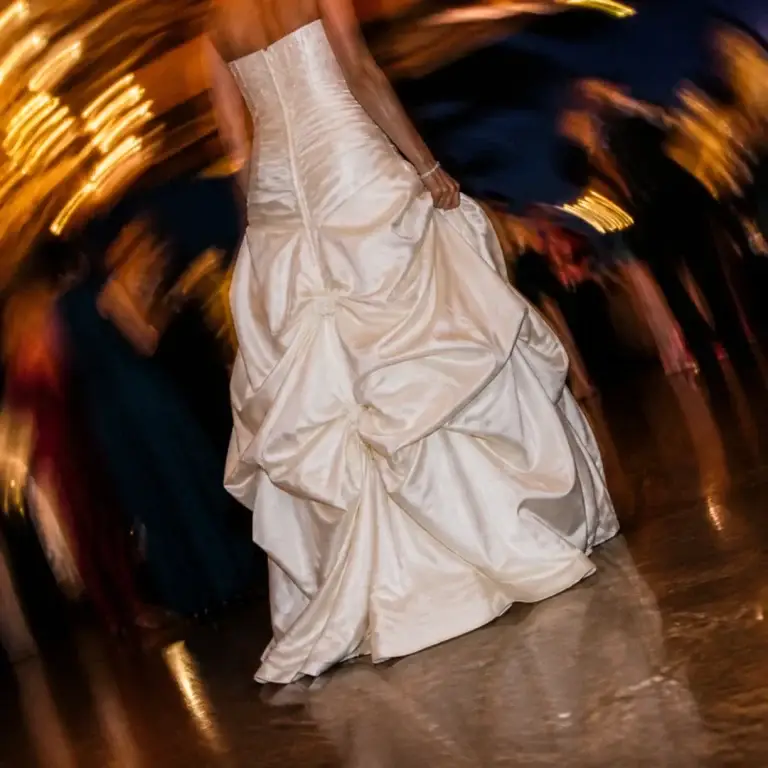
Your train looks perfect walking down the aisle at The Vinoy. An hour later it’s a trip hazard on a crowded dance floor, and your maid of honor is on her knees with a phone flashlight trying to find the right ribbon.
That second moment is why the wedding dress bustle deserves more thought than it usually gets. It’s the one part of your gown that nobody plans for, and the one everybody at the reception ends up depending on.
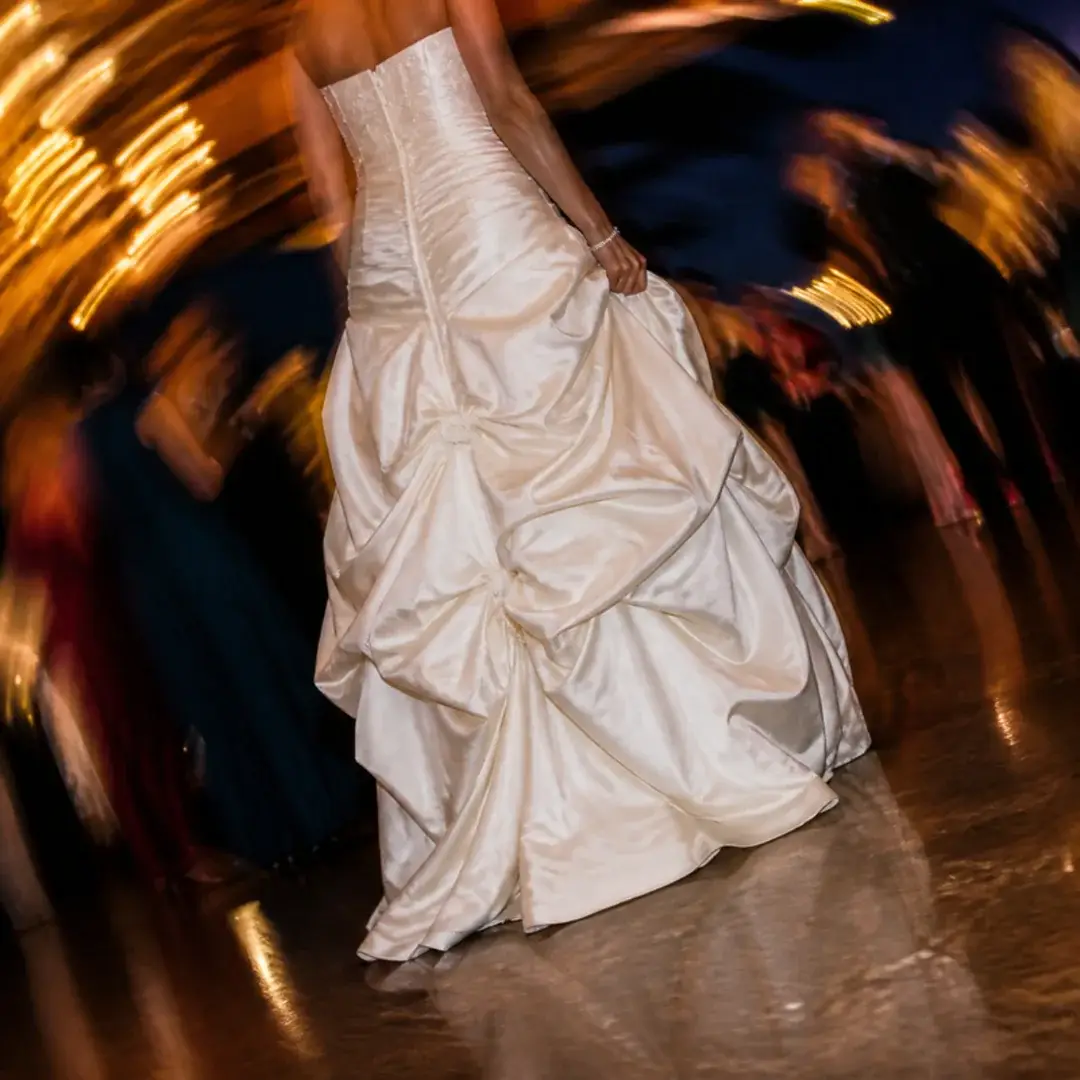
Most brides hear the word for the first time at a fitting. So here’s what we’d tell you ahead of time, from the types to who should learn it.
What is a wedding dress bustle and do you need one?
A bustle is a set of hooks, buttons, loops or ties that lifts your train off the floor so you can walk and dance. If your gown has a train and you plan to do anything but stand still, you need one.
The word has a history. Victorian women wore the original, a shaped back to the skirt, and the Metropolitan Museum of Art notes on a dress from 1885 to 1888 that the bustle first appeared in the late 1860s and came back in the early 1880s. Ours has a humbler job, which is to keep your hem clean and keep your aunt from stepping on it.
A wedding dress bustle isn’t built into most gowns when they arrive. It’s added during alterations, sewn to fit your train and your height. At our St. Petersburg boutique that happens in house, so the seamstress who sets it is working in the same building as the stylist who sold you the gown.
Short sweep train and a casual reception? You might get away with a single hook, or even just carrying it. Nearly every other gown needs more.
Which bustle types should you know before your fitting?
Most gowns end up with either an American bustle, which lifts the train over the top of the skirt, or a French bustle, which tucks it under. Learn those two and you’ll follow nearly any conversation at your fitting.
The American bustle pulls the train up and fastens it to the outside of the gown, usually with hooks or buttons at the back of the skirt. It makes a soft, draped cascade. The French bustle does the opposite, gathering the fabric underneath with ties at several points, which gives a full, puffy look from behind. It’s the one your bridesmaids will curse, because there are often numbered or colored ribbons to match, in the dim light, under a skirt.
Style Me Pretty runs through eight bustle types, including a side bustle, an Austrian bustle that draws up like a curtain, and a wristlet, where the tip of the train loops around your wrist. A ballroom bustle hides the train so well that the gown looks like it never had one.
One warning here. Wedding dress bustle names change from shop to shop, and you may hear American and ballroom used for the same thing. Don’t worry about the vocabulary. Ask to see what it looks like from behind.
How do you choose the right bustle for your gown?
Let the fabric and the back of the gown decide first, then your taste. Heavy fabric and detailed lace limit your options more than most brides expect.
Light tulle usually lifts easily from the top. Heavy satin or Mikado has real weight, and tucking it underneath often sits better and places less strain on a few small points. A lace train is a different case, because a seamstress will want to place the bustle so that the most beautiful part of the pattern stays on show. If your train has a scalloped edge, ask where that edge will land once it’s up.
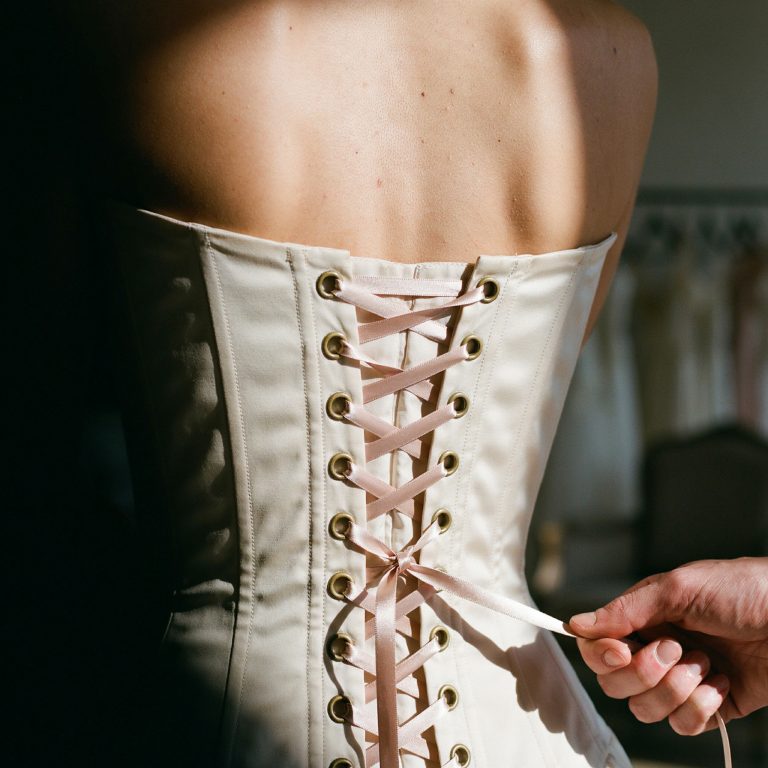
Think about what’s behind you as well. A corset back or a row of covered buttons is a feature, and you don’t want a heavy gathering of fabric sitting right on top of it. Our wedding dress alterations guide explains how seamstresses think through these decisions.
Then match your wedding dress bustle to your actual reception. If you’re dancing all night at a Tampa hotel, you want strength. On a damp lawn in Dunedin or a deck at Clearwater Beach, you want the wedding dress train fully off the ground, because in our rainy months it’ll pick up whatever’s there. Our outdoor wedding dress guide covers those conditions.
There’s a tradeoff in almost every case. The wedding dress bustle that looks prettiest isn’t always the one that’s easiest to fasten, and the one with more points tends to last longer on the dance floor but takes longer to do. Tell your seamstress which matters more to you.
When does your bustle get set at fittings?
Your bustle gets set during your alterations, once the hem is right. Allow 8 to 10 weeks for fittings so there’s enough time to try it, dance in it and change it if you don’t like it.
Order your gown 6 to 9 months before the wedding, and the fittings follow once it arrives. The hem has to come first, because a wedding dress bustle is measured from where the gown actually meets the floor in your actual shoes. Bring those shoes, every time.
When your seamstress pins the first version of your wedding dress bustle, walk around the room. Sit. Turn fast. Ask her to show you what it looks like from behind in the mirror, and take a video on your phone so you can look at it later. Brides often love one version in the fitting room and change their minds at home. That’s fine, and with in house alterations a change is an easy conversation.
If your timeline is short, tell your stylist right away, because a shorter schedule may be workable.
Who should learn how to bustle a wedding dress?
Pick one person who is calm and steady, plus a backup, and bring them to your final fitting. Don’t assume your maid of honor can pick it up from a video an hour before the reception.
You can’t fasten your own wedding dress bustle, since it’s behind you, so someone has to know it cold. We like a mom, a sister, or a friend who isn’t giving a toast at the same moment. A planner can do it too, but confirm that it’s part of her job before you count on it.
Have them do it on the gown at the final fitting, with your seamstress watching, at least twice. Have them film it from their own point of view, because the video from the bride’s side doesn’t help. A strip of tape inside the skirt with a number or a color can help as well if your bustle has several points.
Plan the moment too. Most brides keep the train down through the ceremony and the first portraits, then bustle right before the reception doors open. Build a few minutes into your timeline and find a spot with good light. A dim corridor at an old St. Pete venue is the worst place to discover a missing loop.
Frequently asked questions about bustling your gown
Does every wedding dress need a bustle?
Nearly every gown with a train needs a wedding dress bustle, unless you plan to carry it or remove it. A very short sweep train can sometimes get by without it, but even that can catch underfoot during a long reception. At The Dressing Room in St. Petersburg, your seamstress will look at your train and give you an honest opinion.
How much does a wedding dress bustle cost?
It depends on the work. Alterations at The Dressing Room are priced by the job, and a bustle with more points or a heavily beaded train takes longer than a simple one. We don’t publish a flat price because each gown is different. Ask for a written quote at your first fitting in St. Petersburg, before any work begins.
What is the difference between an American and a French bustle?
An American bustle lifts the train and fastens it to the outside of the skirt, making a soft drape from the waist down. A French bustle tucks the train under the skirt and ties it in place, which creates a fuller, rounded look. Your St. Petersburg seamstress can pin both so you can see them in the mirror.
How long does it take to bustle a wedding dress?
A simple single point bustle can take a minute or two, while a multi point French bustle takes longer, especially with nervous hands in low light. Plan for a few calm minutes before your reception begins. Have your chosen helper practice at the final fitting so nobody is figuring it out while your guests are waiting at the door.
Who usually bustles the dress on the wedding day?
Usually the wedding dress bustle falls to a maid of honor, mother or sister, and sometimes a wedding planner if that’s part of her job. Choose someone steady who will be with you right after the ceremony. Bring that person to your final fitting at The Dressing Room in St. Petersburg so she can practice while your seamstress watches.
Can a bustle break during the reception?
It can, especially when a heavy train hangs from too few points, or when someone steps on it on a crowded dance floor. That’s why strength matters as much as looks. Ask your seamstress to fit the wedding dress bustle to the real weight of your train, and tuck a small safety pin kit into your reception bag.
When should I bustle my dress on the day?
Most brides wait to fasten the wedding dress bustle until after the ceremony and the formal portraits, so the full train shows in the photos. Bustle right before you walk into your reception. At a Tampa Bay venue where portraits happen outside, leave enough time for a quick look at your hem too, since sand and grass can cling to it.
Can you bustle a beaded or lace train?
Yes, but it takes more care. A seamstress has to place each point so the lace pattern still looks good when lifted, and so beading doesn’t catch or snag. Heavy beading adds weight, so the bustle may need extra support. Because alterations happen in house at our St. Petersburg boutique, you can see this worked out on your own gown.
Is there an alternative to a bustle?
Yes. Some gowns have a detachable train that comes off for the reception, and a wristlet lets you carry the tip of the train on a loop around your wrist. A wristlet is pretty for a short while, but it’s less practical for a long night of dancing. Ask your stylist at The Dressing Room what suits your gown.
Where can I get a wedding dress bustle done in St. Petersburg?
If you buy your gown at The Dressing Room, alterations are handled in house at 2425 Central Ave. That means your stylist and seamstress are under one roof, and your bustle is planned along with your hem and fit. Brides from Tampa, Clearwater and Sarasota can complete every fitting at the same St. Petersburg boutique.
Plan your bustle with our St. Petersburg team
The best time to think about your wedding dress bustle is while you’re choosing the gown, because your stylist can show you how each train will behave before you ever order it. Tell us about your venue, your shoes and how hard you plan to dance.
Book your VIP appointment in St. Petersburg and the whole boutique will be yours while you try them on. You can also read how our process works or call us at 727.323.7666. We’re at 2425 Central Ave, and we’d love to see you.